
I'm writing this in May 2026, my umpteenth attempt to post since last October. On re-reading my last piece I'm struck at how ill-at-ease I seemed. This feeling, of being 'unlike me' is real. How I react to it is, I admit, a struggle about who I am and what I do these days. As I read on X recently, “I never had a career. Only work.” Lately I've come to doubt even that.
On a good day I resist this kind of lazy solipsism in a world where deeds, not words, should matter most. The wars currently being waged in the Middle East and elsewhere need no comment from me: the genocides, the broken ceasefires, the startling cruelties are heartbreaking. As for the culture wars closer to home, I hold my thoughts and prejudices to myself, not out of fear of being cancelled for some perceived apostasy, but rather, in the knowledge I was cancelled a long time ago for the crimes of being working class, female and independent-minded.
In October last year I completed the first draft of Tilo im wirklichen Leben (working title), the blueprint for what I hope is my fifth feature film. That I've shot about a third of it is moot; it's my working method. After six years of trying and failing to grasp how to write what I'm writing about, I've arrived at what this story really means: a coming-to-terms with painful events without, as in mainstream films, resorting to violence.
The idea for Tilo began in September 2017. After a weekend on the Isle of Bute with a dear friend, I arrived home to an empty house, made lunch and grabbed the iPad to graze the news. I was caught by a headline in The Scotsman. At that moment I sat, completely paralysed.
The piece was about young male depression and suicide, a subject revisited every September 10th on what is now deemed, "Suicide Prevention Day." It was accompanied by a large black-and-white photo of my nephew, Calum. He had thrown himself in the River Clyde, an act apparently witnessed by several people. A tidal river, the Clyde did not return his body for a week or more; he washed out, he washed in and was reclaimed. He was 21. I had no idea he had killed himself since no one told me.
Stunned, I contacted my brother, Calum's father. He didn't reply - perhaps understandably because he hadn't contacted me to say Calum was missing in the first place. I messaged the author of The Scotsman piece, who did reply. He admitted he didn't know my nephew well, despite the pair operating in the microcosm of Glasgow hip-hop and rap, plying their wares at live gigs and on YouTube. Not long after, the author, Darren McGarvey, who comes from the same Glasgow scheme as our family, quietly unfollowed me on X/Twitter.
This was not my first experience of suicide. In September 2010, my brother, Ross killed himself, aged 40, on his third attempt. On two previous occasions I tried to pick up the pieces left in his wake; the broken relationships, the hospitals searched, the spare bed offered. On his last try, I couldn't be there for him - he had moved to Melbourne in 2003. Yet still I had to pick up the pieces - the post-mortem, the police interviews, his ashes returned to me in a box with a label, "Human Remains" - words as blunt instruments to one's soul.
What troubled me about the deaths of these young men was the unspoken rationale behind them. What led them to think suicide was their only option? Both came from working class households at a time when the definition of "working class" became fluid and when heavy industry collapsed, and the not-so-brave new future dictated by London think-tanks governed by Thatcher was later embraced by New Labour.
What also united my brother and nephew was a desire to escape. Maybe they could and should have got a 'real job' - an apprenticeship at an arms manufacturer in Govan, say, or in the skilled trades - an electrician, a heating engineer, a car mechanic - a solid, secure job with a dependable income. Only they didn't. Why should they? Both were driven to be creative and were willing to work for it; to run off to the circus rather than settle for mere bread.
Ross followed in my footsteps to the Glasgow School of Art to study photography. On graduating, he was suddenly offered a post graduate after a fellow student, a pleasant middle class man whom I knew and liked, committed suicide. My brother's sardonic response, "Dead man's shoes," only betrayed his braggadocio.
My nephew left school. With or without qualifications I have no idea. I know that by the age of 14 he was writing and performing. Too young to enter venues, he performed on the streets outside them where he attracted a following and, eventually, a management deal. That took guts. Calum aka the rapper Lumo was clearly grasping for an identity, a way to affirm himself. His conversion to Islam and his change of name to Mohsen - "poet" - speaks to his struggle, a struggle he lost.
Musing on the obstacles of how to survive, let alone succeed creatively, while having none of the advantages of those higher born - the confidence and fluency in certain circles, the contacts, the blithe attitude to one's material circumstances - I realise how the difficulty experienced in my own writing is a symptom of the anxieties shared with my late brother and nephew. There is, I'm sure, a lot that could be said or written about the intersection of class, anxiety and the futility of artistic ambition if you're low born. Certainly many words have been expended on the subject, mostly by the middle classes.
At the risk of oversharing, last November I was admitted to the Queen Elizabeth University Hospital, aka The Death Star. It was my third stay of the year. The staff at the Respiratory Department struggled to reach a plausible diagnosis and after four days I was discharged, none the wiser. It was then I reasoned how being ill is, like the grief process, effortful and exhausting.
Christmas was a dim memory, as was New Year. By my mid-January birthday, I reminded myself Tilo wasn't going to make itself. By February I resolved not to let 2026 go to waste and so to avoid another year of self-doubt and self-pity, finally I sat myself down with a yellow legal pad to begin weeding the words I had written. After all, writing is re-writing.
As a writer and filmmaker, sometimes you work with the material you're given, sometimes you have to create that material from scratch. When I set out on this project in 2017, I was determined on an original, even surreal approach to the story and its themes of creativity, suicide and cultural iconoclasm. With the world in such a parlous state, when the obscenities of war sit next to the end-time spectacle of say, the Met Gala, when black is white and truth is lies, I might as well invent my own.
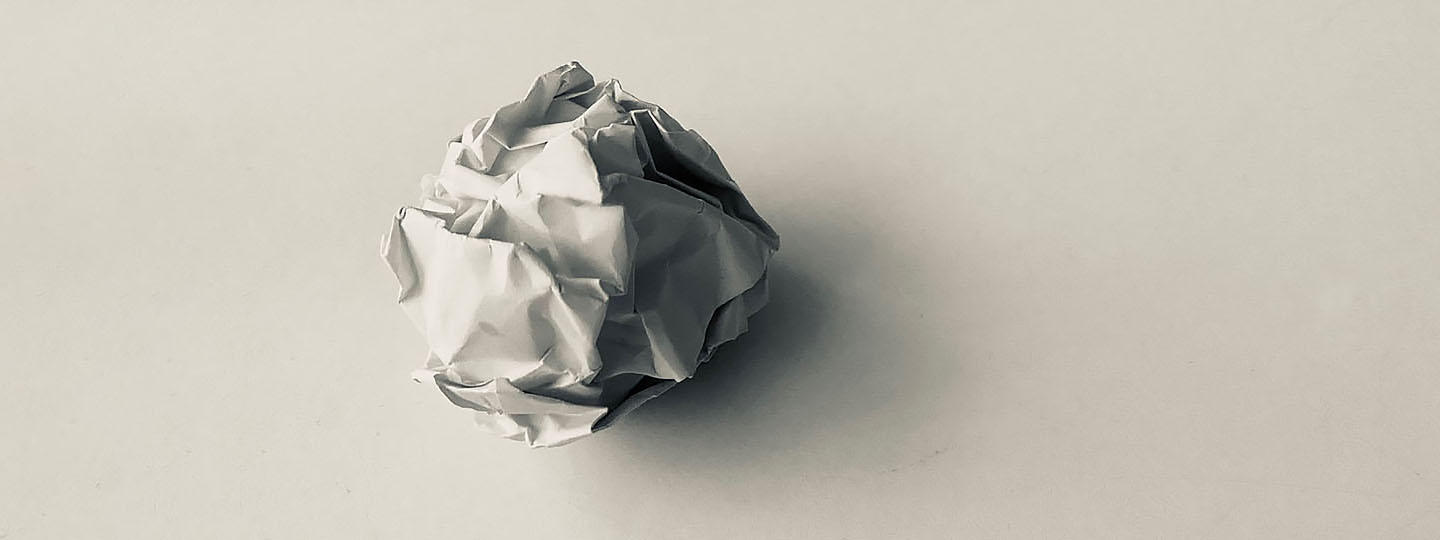
The above image is of a screwed-up ball of paper, that eternal signifier of writer's block. I'm sure it will find a place in the film. Inshallah.